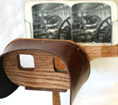
 1905 The first school museum open in St. Louis.
 These museums “served as the central administrative unit(s) for visual instruction by (their) distribution of portable museum exhibits, stereographs, slides, films, study prints, charts, and other instructional material (Saettler, 1968). It is interesting to note that these materials were regarded as supplementary instruction media and were not meant to replace the teacher or textbook. At this point the technology was regarded more as a novelty than educational media. For many people viewing the exhibits was their first experience with motion film.
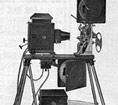 1910- The Visual Design Movement
 The first catalogue of instructional films is published. Rochester, New York school system becomes the first to use films for regular instructional use. During the period between 1914-1923, several national professional organizations were established for visual instruction including The National Academy of Visual Instruction, The Visual Instruction Associatin of America andd the NEA Department of Visual Instruction. In 1932 the National Academy of Visual Instruction merged with the NEA Department of Visual Instruction.
 1930's - The Audio Visual Movement
 Technological advances lead to the adaptation of sound recordings and sound motion pictures. Visual instruction becomes known as Audiovisual Instruction. During this period radio begain receiving a greal deal of attention and was hailed by some as the next great instructional tool that would revolutionize education.
A number of textbooks on the subject of audio visual instruction were written during the 1920's and 1930's(Reiser, A History of Instructional Design and Technology). One of the benefits realized was the ability of audio visual technology to present information in a realistic manner. Unfortunately, the media was not well recieved or utilized by the education profession.
 world War II Instructional Materials
- Audiovisual devises are used extensively by the military and industrial institutions during the war. The Air Force alone produced over 400 training films and 600 filmstrips. Training films were also used to prepare American civilians to work in industry. A wide variety of instructional materials and equipment are employed in the military forces. Devices that were used extensively were the overhead projector, slide projectors, simulators, and trsining devices. It has been speculated that America's ability to adapt and deploy film for educational on a national scale was one of the determining factors in deciding the outcome of the war.